2026: Volume 5, Issue 1
Current Issue
 Abstract
  PDF
PDFZeolites in CO₂ Activation and Conversion: Mechanistic Consensus, Controversies, and Catalyst Design Principles
Bashir Ahmad Dar 1*, Naseem Fatima 2, Shamim Ahmad Dar 3
1Department of Chemistry, Government Degree College, Uri, Baramulla, 193123, J&K, India
2Department of Physics, Government College Autonomous Kalaburagi, Gulbarga, 585105, Karnataka, India
3Department of Zoology, Government Degree College Sogam 192231, India
Received Date: January 01, 2026 Published Date: April 27, 2026
*Corresponding author: Dr. Bashir Ahmad Dar, Department of Chemistry, Government Degree College, Uri, Baramulla, 193123, J&K, India, Phone: +918491828956, E-mail: [email protected]
Citation: Dar BA, Fatima N, Dar SA. (2026). Zeolites in CO₂ Activation and Conversion: Mechanistic Consensus, Controversies, and Catalyst Design Principles. Catalysis Research. 5(1):21.
Copyright: Dar BA, et al. © (2026).
ABSTRACT
Carbon dioxide cycling via catalytic conversion into fuels and value-added chemicals has drawn significant attention as a pathway to carbon circularity; however, the efficient activation of this thermodynamically stable molecule remains an overarching fundamental challenge. Zeolites have evolved from mere passive supports into programmable catalytic microenvironments in which framework composition, acid–base properties, pore topology and metal confinement all play roles to dictate CO₂ adsorption, intermediate stabilization and product selectivity. This review provides an assessment of the mechanistic roles presented by zeolite-based materials in important CO₂ conversion pathways, including hydrogenation to methanol and hydrocarbons, cycloaddition with epoxides, and coupling with amines. Specific attention is paid to differentiating between well-known mechanistic aspects and those whose existence is yet to be confirmed. Current evidence indicates that Lewis acidic cations, metal–oxide/zeolite interfaces, and confined metal species are the dominant motifs for primary CO₂ activation. In contrast, Brønsted acid sites more commonly stabilize oxygenated intermediates, mediate proton transfer, and influence downstream transformation chemistry rather than directly protonating CO₂. Across reaction classes, catalytic performance is governed recurrently by metal nuclearity and dispersion, acid–base balance, confinement, and hierarchical porosity. The review also highlights key limitations that have prevented progress towards the rational design of catalysts for translation purposes, including inconsistent benchmarking, operando studies of elementary processes, catalyst deactivation in real feedstocks, and the scalability of highly complex catalysts. The review concludes with a discussion of some exciting new areas such as single-atom catalysts, tandem catalysts, membrane reactors and data-driven design of catalysts.
Keywords: Zeolites, CO₂ Activation, Hydrogenation, Cyclic Carbonates, Heterogeneous Catalysis, Acid–Base Sites
INTRODUCTION
The sharp rise in atmospheric carbon dioxide (CO₂) caused by industrial activities and extensive fossil fuel use is among the most urgent environmental issues of the 21st century. In 2024, CO₂ levels in the atmosphere exceeded 424 ppm, marking the highest level ever recorded in human history [1]. Such a significant increase largely drives global temperature changes, ocean acidification, and extreme weather events, highlighting the urgent need for measures to cut CO₂ emissions and reduce ecological impacts [2]. Besides emission reduction, converting carbon dioxide into valuable chemicals and fuels using green technologies is a promising option for carbon storage. This approach not only becomes a source of energy but also enables resource valorization. However, CO₂ is a very stable and essentially non-reactive compound, making it difficult to activate and convert under normal operating conditions. To effectively transform CO₂, molecules must be broken down by selective catalysts and reaction pathways controlled to produce desired products. Over the past decade, zeolites have shown the most promising active-site structures for this purpose, thanks to their unique and adjustable frameworks, acidity, and chemical properties. Their structure offers high surface area, shape- and size-selective cavities, and Brønsted and Lewis acidity—all factors that can limit zeolites' catalytic effectiveness. Adding metal ions or clusters can enhance their catalytic performance and mechanistic control by enabling the selective activation of CO₂, which is a very stable and small molecule [3,4].
From a mechanistic point of view, the polarisation of the C=O bonds in CO₂ is a prerequisite for the binding and the subsequent activation on catalytic surfaces, and this can be done by adsorption onto an electron-rich or electron-deficient site [5]. Zeolites have a vast number of such sites: Lewis acid sites and exchanged metal cations can coordinate and weaken C=O bonds, while Brønsted acid sites are more plausibly involved in hydrogen-bond-assisted adsorption, intermediate stabilization, and proton-transfer steps than in direct primary activation of CO₂ itself. The success of these processes depends to a great extent on the topology of the framework, the size of the pores, and their connectivity, which determine CO₂ diffusion, adsorption, and access to reaction sites [6]. Innovations in this area have revolved around the modification of zeolites with hierarchical pores, metal (Cu, Zn, Fe) impregnation, and post-synthetic functionalization with organic linkers to achieve controlled acidity, hydrophobicity, and CO₂ adsorption capacity [7]. These methods have allowed the production of methanol, formic acid and cyclic carbonates from CO₂, besides improving mass transport and lowering the diffusion resistances. On top of this, the problem of how to engineer zeolite-based catalysts that would exhibit these features and also be stable under real industrial conditions is still far from being solved. A deep insight into the relationships between the metal sites, the acidity of the framework, and the mechanisms of CO₂ activation will surely pave the way towards the design of new catalysts [8]. This article reviews the comprehensive experimental account of the latest advances and challenges of zeolites in the activation and conversion of CO₂, with the focus shifted to the interplay of structure-properties-reactivity. This comparative analysis also reveals the ways a zeolite catalyst functions, and it also serves as a tool for the design of novel zeolites with CO₂ utilization capability, an important step towards a circular carbon economy.
Although substantial progress has been made in developing zeolite-supported catalysts for CO₂ conversion, the field still lacks a unifying mechanistic framework that links zeolite composition, acid–base functionality, confinement, and interfacial architecture to catalytic performance across different reaction classes. Reported activities and selectivity are often difficult to compare directly because they are strongly influenced by catalyst topology, porosity, metal dispersion, acid-site distribution, and reaction conditions [3,4]. In addition, the relative roles of Lewis acidic centers, Brønsted acidity, metal–zeolite interactions, and confinement effects remain unevenly resolved across hydrogenation, cycloaddition, and tandem conversion pathways. Consequently, parts of the literature remain either mechanistically fragmented or prone to overly broad generalization [6]. This review, therefore, aims not merely to catalogue reported catalysts but to distinguish mechanistic consensus from ongoing debate, extract transferable structure–property–reactivity principles, and identify practical design rules for the next generation of zeolite-based CO₂ conversion catalysts.
REVIEW METHODOLOGY
This review was designed as a targeted, mechanistically oriented assessment of zeolite-based approaches to CO₂ activation and conversion. The references included in the study are predominantly based on papers published in peer-reviewed journals and databases, covering mostly the years between 2015 and 2025, while selecting several fundamental papers before that time if they provide valuable mechanistic insight.
The literature search was done using various keyword combinations such as "zeolite CO₂ activation," "CO₂ hydrogenation zeolite," "metal-exchanged zeolite CO₂," "cyclic carbonate zeolite," "CO₂ amine coupling zeolite," "hierarchical zeolite CO₂," "operando spectroscopy zeolite CO₂," and "single-atom zeolite CO₂ catalysis." Preference was given to original research articles describing catalyst preparation and characterization methods, experimental evidence related to mechanisms and catalytic performance, rather than review papers used only for contextual discussion. The literature was comparatively assessed according to the following criteria:
(i) type and localization of active centers (Brønsted, Lewis, metal, interfacial), (ii) topology and porosity of zeolite structures, (iii) direct experimental evidence about elementary stages and/or intermediates using techniques like operando/in situ spectroscopy, isotope labelling experiments, kinetic analysis, and density functional theory calculations, (iv) performance indicators like selectivity, space-time yield, turnover frequency, and stability, and (v) applicability, including catalyst longevity, regeneration, and scale-up.
STRUCTURAL AND CHEMICAL FEATURES OF ZEOLITES
Zeolites are a group of crystalline aluminosilicates with a three-dimensional network made up of connecting SiO₄ and AlO₄ tetrahedra. The replacement of Si⁴⁺ by Al³⁺ in the tetrahedral framework results in a negatively charged unit that is usually balanced by cations derived from outside the framework, e.g., H⁺, Na⁺, or transition metal ions [3]. This structural makeup is the source of their wide structural variety and also their chemical modifiability, which are indispensable properties for the activation of CO₂ catalytically.
Framework Composition
The Si/Al ratio in zeolites substantially influences their properties, like acidity, hydrophobicity, and thermal stability. In general, low-silica zeolites contain more Brønsted acid sites due to the larger number of AlO₄ units present, whereas high-silica zeolites are more hydrophobic and thermally stable [8]. The structural features of the framework, i.e., pore size, channel connectivity, and cage geometry, determine the molecular diffusion as well as access to the active sites. Hierarchical zeolites that combine micropores with meso- or macropores have been created to overcome the limitations of diffusion and improve mass transport, thus allowing higher catalytic efficiency in CO₂ conversion reactions [7].
Acid–Base Properties
The acid–base character of zeolites is key for their catalytic function; however, it should be properly interpreted within the scope of CO₂ activation mechanisms. Generally, zeolites possess Brønsted acidic sites, which are usually represented by bridged Si–OH–Al pairs, and Lewis acid sites as depicted in Figure 1, which typically include extra-framework cations, coordination-inactive metals, or defect areas. The roles played by the latter and former types of sites in the reaction cannot be considered similar [9]. In most cases, the activation of CO₂ in zeolite catalysts involves the involvement of Lewis acidic cations and metal centers, which can coordinate to the oxygen atoms of CO₂ molecules and distort their linear structure. In turn, the secondary processes that accompany this stage, such as the stabilization of oxygen-containing products, the transfer of protons, and further reactions, are often linked with Brønsted acidic sites. Thus, the presence of high acidity does not necessarily mean an effective activation of CO₂ [10].
The activity of zeolite-based catalysts, as well as the success of the CO₂ activation process, relies less on "high acidity" than on the rational distribution and location of metal and acid–base sites. High acidity may cause unwanted side reactions and result in coke formation; thus, it is better to achieve a balance between both types of acidity [11].
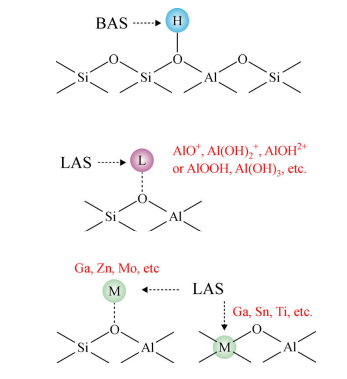
Figure 1: Depiction of acid sites in zeolites: Brønsted acid sites, Lewis acid sites, and metal addition-induced modified Lewis sites, all of them being different catalytic functionalities. Adopted from [11].